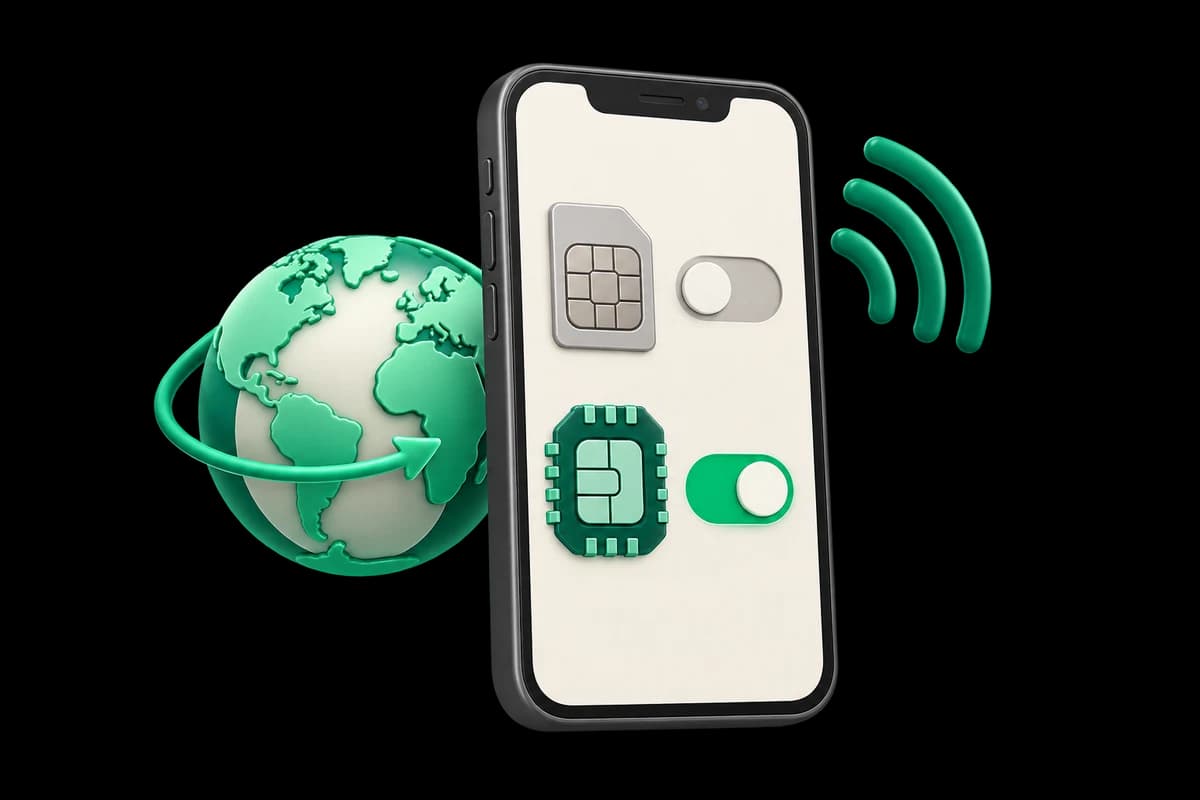
To choose data for Lisbon, Madeira and the Azores, check two separate things: whether the package includes Portugal, and which networks that particular package supports. Then compare your actual itinerary with the operator's coverage information. A country listing does not certify signal on every island, road or walking route. The Portuguese examples below list Vodafone and NOS, but that list does not establish a continuous connection between the mainland and the archipelagos either.
Draw the itinerary first: mainland, Madeira and Azores
A trip to Portugal might mean a city stay in Lisbon, a railway journey to Porto, beach time in the Algarve or several stages separated by flights. The pinned Portugal article from Wikivoyage used here treats Madeira and the Azores as island destinations with their own natural attractions. It makes sense to prepare them as separate stages, with their own arrivals, accommodation addresses and onward connections, rather than as an extension of a Lisbon street map.
The source's transport section identifies flying as a principal way of reaching these archipelagos and travelling between their islands. It distinguishes Funchal and Porto Santo for Madeira, and names Ponta Delgada, Terceira, Horta, Pico, Flores and Corvo among Azorean arrivals. These are useful names for a checklist. If you land on one island and sleep on another, ask about the places on both islands, rather than asking only whether the country is covered.
Connectivity becomes relevant again after each arrival. You may need the accommodation address, instructions for another transfer or a way to update someone waiting for you. Our editorial recommendation is to save those documents for each stage before leaving the previous one. The essential information should not exist only inside a message that still needs to load when you have not yet checked the travel line.
The pinned travel context also notes a time difference between the Azores and the rest of Portugal. We do not use that reference to invent a contractual expiry time for the eSIM. For flights and reservations, confirm the local time on the current travel document. For the data package, check the activation event and the expiry information on the order separately. A local clock and a package's validity are different questions.
What a package listing Portugal actually tells you
The examples identify Portugal, country code PT, and list Vodafone and NOS. This answers the commercial questions of which destination the product admits and which operators appear as connection options. It does not tell you where every antenna is, what reception is like inside a room, or what signal you will receive on a mountain road. Those require information about the actual location.
For Madeira and the Azores, make the request specific: island name, accommodation town and planned excursions. If the product description does not clarify its island scope, request confirmation before buying. Then check the operator's published coverage information for the locations that matter. Keep the two answers separate: product eligibility for a destination and a usable radio signal at a particular point are both necessary, but they are not the same fact.
The distinction also applies in Lisbon. Being in a capital does not establish permanent mobile service inside every building, tunnel or vehicle. An operator's presence in the package list does not mean that all its technologies will be available at every moment. A technology label in the catalog is not a minimum bandwidth commitment for your room or a boat journey. If you need to work at a particular time, ask about the connection at the place where you will be working as well.
An orderly comparison can use three notes: countries included, operators listed and places where you depend on the phone. The third note comes from your itinerary; the first two must come from the current product. If you continue to Spain, do not infer inclusion because both destinations lie on the Iberian peninsula. These PT examples do not, by themselves, establish eligibility for ES.
Lisbon and Porto: stations, neighbourhoods and written addresses
The source describes Lisbon and Porto as the country's largest cities and notes their metro systems and suburban railway connections. It also places Porto's Cais da Ribeira waterfront and Lisbon landmarks such as the Jerónimos Monastery and São Jorge Castle in its destination context. This helps identify the information worth retaining offline. You do not need to reload an entire guide every time you want to remember the station or area you intend to reach.
As an editorial preparation step, save a map of your accommodation area, the written address and the station for the next journey. Retaining the original Portuguese name helps you compare a sign with your reservation. The source explains that Portuguese and Spanish share many elements but are not identical in pronunciation and use. A written destination remains useful even when you understand some of the conversation but cannot confidently recognise a spoken place name.
For outings from Lisbon, the corpus mentions Sintra, Cascais and Almada. That gives you a small group of possible destinations to organise in your notes, without this article promising journey times, frequencies or coverage in each one. When changing accommodation, save the next address before leaving the previous place. The eSIM may help you check an update, but the ticket or reservation is still a document separate from your data purchase.
Porto, Coimbra and Lisbon also appear in the railway context. The recommendation is not to buy more data simply because the itinerary contains more cities. Look at what you do with the connection: checking directions and messages is different from sharing it with a computer or syncing files. We have no verified conversion between gigabytes and a number of sightseeing days. Choose according to your own habits, and use the phone's usage counter as an additional reference alongside the order status.
Mainland journeys by train, bus and road
The source identifies Entroncamento as an important railway junction and distinguishes services joining major cities from services reaching inland destinations. It names Braga, Aveiro, Coimbra, Lisbon and Faro, and includes Évora, Beja and Guarda in the intercity context. We omitted source discounts, fares and frequencies because they can change and are unnecessary to resolve the connectivity decision.
For a railway journey, save the ticket, departure station, destination and accommodation details. Internet can help you obtain current information, but it should not be the only way to remember where you intend to leave the train. This article does not establish continuous mobile reception along a railway route. A line connecting two cities is not proof that a phone maintains a data session on every section between them.
The source also explains that trains do not reach every part of the country and that intercity and regional buses fill transport gaps. When travelling outside the main cities, do not prepare maps using the rail network as your only reference. Add the bus stop or meeting point and the final address. Separating a town's name from the terminal's name can be useful when the travel document uses a more specific arrival point.
For driving, the corpus distinguishes motorways and national, regional and municipal roads. It notes orientation difficulties in some rural areas and limitations of following an automatically suggested digital route. We do not reproduce traffic laws or toll instructions here. The connectivity recommendation is narrower: save the relevant map area and review the route before driving. A navigation app with internet access does not replace road signs or the driver's assessment of the actual road.
Prepare Madeira and Azores arrivals as individual stages
The source associates the archipelagos with natural landscapes and distinguishes them from mainland destinations such as the Douro Valley, Peneda-Gerês and Serra da Estrela. That variety matters for phone preparation. Staying in a town and travelling to a natural site do not raise the same location-specific coverage question. Portugal in a package listing does not replace a query about the area where you will spend time away from your accommodation.
Before an excursion, save its start point, return point and the instructions supplied by the activity or accommodation provider. This is a planning recommendation, not a claim that a particular route lacks reception. We have no measurements for island trails, viewpoints or roads in this article. For that reason, we do not publish a coloured coverage map that would appear to certify service in places we have not checked.
Between islands, or between an archipelago and the mainland, the package does not establish onboard internet merely because Portugal is included. Any Wi-Fi offered by a transport service has its own terms. Save what you need before departure and check the travel line again after arriving. If data does not return, review line selection and roaming on the eSIM; do not delete the profile as your first attempt to fix the connection.
If travelling with another person, agreeing on a meeting point and retaining a shared address offline reduces dependence on an instant message. This preparation is useful on an island and at a Lisbon station. It is not a prediction of service failure. It recognises that a mobile package has a finite allowance and uses a physical network, while neither element replaces all the information needed for the journey.
Two real Portuguese package examples
The product reviewed on 8 October 2026 includes Portugal 1GB 7Days, identifier PT_1_7: 1 GB and seven days of validity. Its activeType=2 means the period starts with the first connection to an eligible network. The stated installation window is 180 days. The listed operators are Vodafone and NOS, and sharing is enabled as hotspotSupported=true. Traditional calls and SMS are not included.
The second example is Portugal 5GB 30Days, identifier PT_5_30: 5 GB and 30 days, again with activeType=2 and a 180-day installation window. It lists Vodafone and NOS and enables hotspot according to the catalog. It also excludes calls and SMS. Installing within the allowed window and starting the service period are separate concepts. Confirm these same fields on the product you buy, since a similar name does not establish identical conditions.
Both records show the technology label 3G/4G/5G and the provider-reported routing label FR/NL/UK. Neither is a bandwidth guarantee or a verified IP address for every session. Their fair-use-policy field is blank in this snapshot: that means no policy text is supplied in that field, not unlimited data or guaranteed absence of restrictions. The stated allowance remains finite at 1 GB or 5 GB.
Sharing uses the same allowance and does not create a second reserve for a computer. We also do not promise a store top-up button: supplier top-up metadata does not establish a confirmed customer purchase flow in the store. Check the current plans to compare the exact package, included destinations and present conditions.
Install and check the line before relying on it
You need a compatible, carrier-unlocked device. Install using reliable internet and the order's QR or manual installation details, and keep those codes private. Menus vary by model and software version. The line-management instructions from Apple and Google Pixel can help identify the relevant controls, while order-specific settings must come from the order.
After arrival, choose the travel eSIM for cellular data and enable roaming on that line as instructed. Review the home line separately and disable its data roaming and automatic data switching if those controls exist. This is not a guarantee against voice charges or other services from the home operator. Check which line is selected before opening applications that rely on internet.
If you see signal but a page will not load, keep the profile and first check data-line selection, roaming and the order's APN. Do not substitute an APN from another article. Record the package, device, island or town, displayed operator and error message when requesting help. The installation FAQ collects general checks; deletion, transfer or reinstallation needs specific instructions, rather than an assumption that it is always possible.
Questions about this itinerary
Does Portugal in the listing guarantee every Azorean island?
No. It identifies the admitted destination, not a service measurement on every island. Confirm the product's island scope and your actual locations. Vodafone and NOS are names in these examples, not a promise of uninterrupted combined coverage at every point.
Do I need another package just to move from Lisbon to Porto?
These examples list Portugal. Changing city does not, by itself, establish a need for another package; remaining data, validity and local service still matter. For another country, check inclusion explicitly. The Spain installation guide and France and European itinerary comparison address relevant next stages.
Can a seven-day package cover a longer stay?
PT_1_7 has seven days from its stated start event, not from the last time you checked a page. Unused data does not prove continued validity after expiry. Compare both available data and available time; the 30 days of PT_5_30 do not make its 5 GB unlimited either.
Sources, credit and scope
Destination context is an edited English selection and adaptation of Portugal on Wikivoyage, revision 5264578, written by its contributors, whose work appears in the history. The corpus was curated by vincentss/enwikivoyage-retrieval-202605. Geography and transport context were retained; fares, schedules, incomplete fields and changeable claims were omitted. This textual adaptation is available under CC BY-SA 4.0; brand graphics are excluded. Preparation recommendations and package facts are editorial additions reviewed on 8 October 2026, not guarantees of future conditions. eSIM Access activation documentation and roaming documentation complement the order checks. This edition preserves the scope of the Spanish companion and uses a pinned travel-source snapshot.