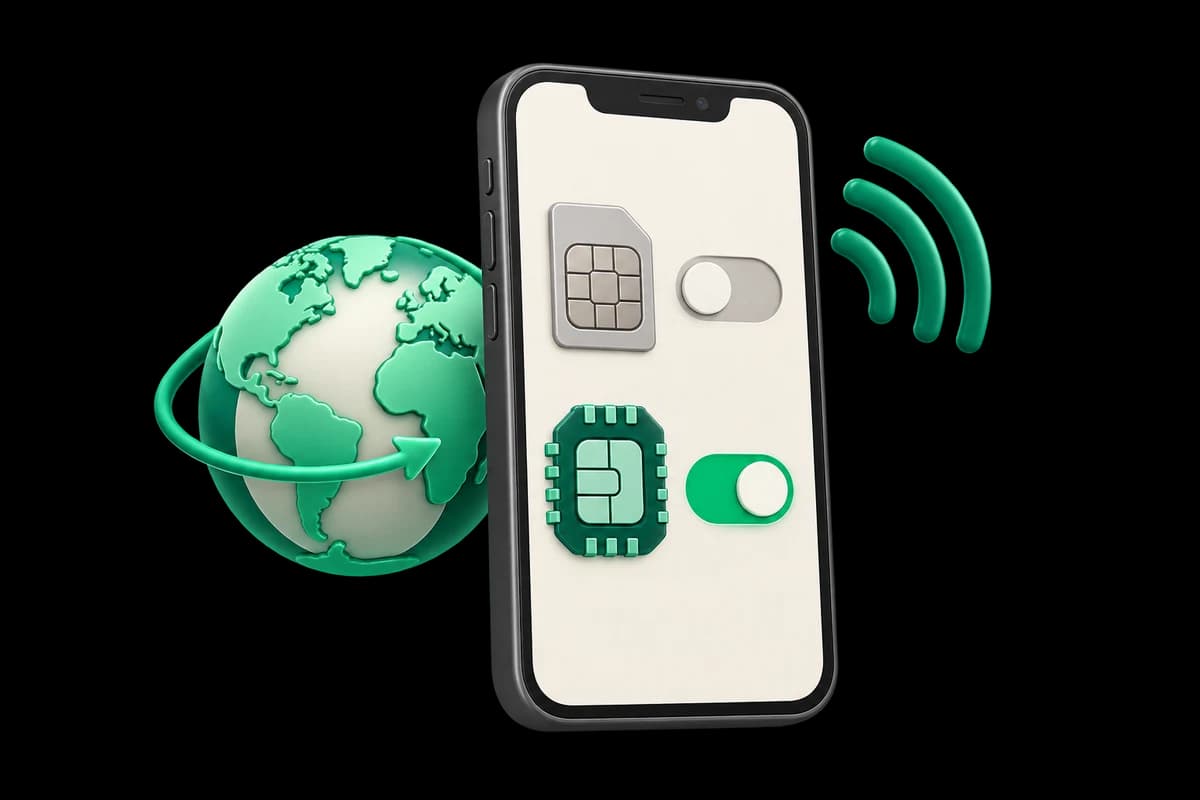
A Canada eSIM's validity can start on installation, at its first eligible connection or from purchase: the exact package determines the event. In the checked selection, CA_0.1_7 starts on installation, CA_1_7 and CA_5_30 start at the first eligible connection, and CA_75_30 starts from purchase. Do not use “I activate it when I arrive” as a universal rule. Identify your product first, then decide when to buy, install and select its data line.
Three moments that are often confused
Buying creates an order. Installing downloads a profile to the phone. Connecting registers that line on a network permitted by the package. These moments can occur together or on different days. The validity mechanism determines which event begins the contracted period, so advice suitable for one package can undermine the timing of another.
The product information uses activeType. In these examples, 1 means start on installation, 2 means start at the first eligible connection and 3 means start from purchase. The number is not a quality or speed ranking. It describes a timing rule. Keep it beside the package name and order instructions.
“Activate” is sometimes used for any of those steps, making errors easier. Ask precise questions: which event starts the days, how much data is included, how long does it last from that event, and which installation window is published? We do not replace an absent field with another product's number or assume switching off the phone stops the clock.
Canada context comes from a pinned Wikivoyage revision. Base product fields were checked on 8 October 2026, and CA_75_30's additional features were checked with the provider on 9 October. Timing information depends on the commercial product, not the dataset's destination description. We therefore describe four products separately instead of generalizing one mechanism across the Canadian catalog.
CA_0.1_7: installation starts the seven days
CA_0.1_7, Canada 100MB 7Days, contains 100 MB valid for 7 days. Its activeType is 1, so installation starts the period. The stated installation window is 180 days, but that window does not convert the seven-day usage period into time you can keep untouched after installation.
It lists Rogers Wireless labeled 5G, permits hotspot and includes neither traditional calls nor SMS. The general technology field is 3G/4G/5G, and IP routing is labeled US in the current check. Neither that label nor the operator name establishes one particular address or speed for every session.
The practical consequence is to inspect the calendar before installing. If travel is still some days away, an early test can start validity before you reach Canada. We do not solve this by assuming reinstallation, transfer or suspension: those options are not guaranteed here. Follow the order instructions and ask support before a step you do not know how to reverse.
The 100 MB describes the product's allowance. We do not claim it is enough for a particular trip without knowing usage or calculate how many maps or messages it represents. Compare another combination of allowance and time before installation if required. Small volume does not change the timing mechanism, and hotspot does not multiply the balance.
CA_1_7 and CA_5_30: first eligible connection
CA_1_7, Canada 1GB 7Days, offers 1 GB valid for 7 days. It records activeType 2 and a 180-day installation window. The period starts at the first eligible destination-network connection, rather than installation. It lists Rogers Wireless labeled 5G, permits hotspot and includes no traditional calls or SMS.
CA_5_30, Canada 5GB 30Days, offers 5 GB valid for 30 days. It also records activeType 2, a 180-day installation window, Rogers Wireless labeled 5G and permitted hotspot use. The 5 GB is total allowance, not daily data. Time and volume are independent limits: remaining days do not prove remaining data, and remaining data does not automatically extend validity.
Both examples use the general technology label 3G/4G/5G and IP routing label US. Their fair use fields are empty. This indicates no published text in that snapshot field, not infinite data or a promise of unrestricted performance. We do not invent a throttling rule absent from the evidence.
To prepare either product, read the order and installation window before downloading the profile. After reaching a place where the line can connect, select it for data and follow roaming instructions. The first eligible connection is the relevant event. We do not claim the clock starts upon landing, because landing and registering on a network are different events.
CA_75_30: thirty days start from purchase
CA_75_30, Canada 75GB 30Days, contains 75 GB valid for 30 days but uses activeType 3. The period starts from purchase. Installing later or keeping it switched off should not be interpreted as reserving those thirty days intact for another date. Consider the travel calendar before confirming the order.
This package lists Telus labeled 5G and permits hotspot. Unlike the three preceding examples, the fresh provider description includes unlimited local calls within Canada during validity, unlimited SMS and MMS during that period, and a Canadian number assigned after arrival in the country. This variant should not be described as data-only. Its general technology field says 3G/4G/5G and IP routing is labeled CA, without guaranteeing a particular Canadian address in every session.
The provider description states 75 GB of high-speed data and a reduction to 128 Kbps after that allowance is exhausted. This condition does not support advertising unlimited high-speed data or promising performance for a particular task after the limit. Read full order conditions before depending on the reduced connection for an activity requiring more performance.
It also includes 1,000 international calling minutes to 15 provider-listed destinations: Mainland China, Hong Kong, Macau, Taiwan, the United States, Mexico, Australia, New Zealand, Japan, South Korea, Singapore, Malaysia, Thailand, Indonesia and Vietnam. This is a calling-destination list; it does not add countries to mobile coverage. We do not advertise unlimited international calls or minutes to destinations absent from that selection.
For usage checks, the provider instructs sending CHECK to 1888 from the relevant line. Installation is particularly important: the product allows a single installation, and deleting the eSIM prevents restoration or reinstallation. Keep the profile and consult support before modifying it. These details belong to CA_75_30 and must not be transferred to CA_1_7, CA_5_30 or CA_0.1_7.
No numerical installation window is published for this product in the snapshot. We do not copy the Rogers examples' 180 days into it. Nor do we promise a customer top-up flow at eSIMStore: CA_75_30 has different extension metadata from other examples, but a provider field does not establish a store button or available customer operation.
Canada: why itinerary duration matters
The source describes a very extensive country with large sparsely populated areas and much activity concentrated in the south. It also presents Rocky Mountain landscapes, Atlantic and Pacific coasts, lakes and northern regions. These references help avoid a data calendar designed as if every stage were a nearby urban visit.
A trip combining regions can involve transfers and accommodation changes in addition to sightseeing. When comparing seven-day and thirty-day products, count the whole journey from the event starting validity. Do not count only days when you expect heavy internet use. An activated product's period is not described here as a screen-time counter.
The source also shows that local times and transport schedules need attention when changing regions. We do not reproduce current seasonal-clock or time-zone rules without additional verification. Retain the purchase moment and activation information supplied by the system. A local time change during travel does not imply a reset of validity.
A coast-to-coast itinerary is not continuous coverage between both coasts. Rogers Wireless or Telus in product information identifies package networks, not guaranteed connectivity in every forest, mountain, building or road. Check current information about the location and service if data is needed at one specific point.
The geographical section describes the Canadian Shield around Hudson Bay and different coastal and mountain landscapes. For data preparation, these are reasons to identify your actual route instead of treating “Canada” as one uniform physical environment. The text does not establish reception on those landscapes. Save the arrival point and instructions for each stay, and ask the relevant provider about any task that depends on being connected there.
Urban corridors and long-distance journeys
Wikivoyage distinguishes the Quebec City–Windsor railway corridor through Montreal, Ottawa and Toronto from other long-distance routes. This helps organize resources: tickets, departure station, next accommodation and local addresses. The eSIM can facilitate information checks but includes no ticket and does not establish current timetables or availability.
The source also describes journeys linking Toronto and Vancouver or Montreal and Halifax, along with other routes across large regions. Validity remains relevant on a journey of several days even if the phone is unused for stretches. Save documents before leaving and avoid making ticket access dependent on continuous data throughout the route.
For Montreal, Vancouver and Toronto, the corpus presents urban and suburban transit as an alternative to always using a car. Keep the station name and arrival address. Do not extend that context to every Canadian location. A stage outside a major city may require different information and organization even within the same contracted country.
Road networks and natural destinations also feature in the source. For a road journey, save the itinerary and bookings and confirm conditions with their providers. We do not reproduce dataset rental terms, rules or prices as current information. The purpose is to prepare data and timing, not replace other service documentation.
The railway source mentions routes toward Churchill, Prince Rupert and other places beyond the central urban corridor. These references show why the stage name matters when storing travel documents. An intercity booking should be kept with the correct arrival and onward transfer, rather than an unrelated city transit map. They do not establish present departure dates, frequency or continuous mobile service.
Plan the start without mixing products
For activeType 1, choose the installation time knowing that it starts the days. For activeType 2, check the installation window and first eligible connection event. For activeType 3, plan the purchase time because ordering starts validity. These are three separate decisions; the QR's appearance does not identify which applies.
Organize each order by name, allowance and validity. If several people travel, avoid naming profiles only “Canada,” since products may have different mechanisms. Keep every QR private and do not exchange them for tests. A phone change or deleted profile has no guaranteed reinstallation under this guide.
Consult current plans and check the product you intend to buy, even if you used a Canadian eSIM before. Catalogs can change. For configuration, use the eSIMStore FAQ and order instructions. Someone else's experience with a product for the same country does not establish your product's timing rule.
Before confirming a time-sensitive purchase, compare the published start event with the first stage at which you expect to use it. This is especially important for the purchase-start product because storing its QR is not evidence that its clock remains unstarted. Keep the order receipt so a question about timing can refer to the actual product and purchase, rather than an assumed rule from another guide.
Checks on arrival and during travel
You need an eSIM-compatible, carrier-unlocked device and dependable internet for installation. Download the profile using the order's QR or manual details. In a covered area, select the travel line for data and enable its roaming as instructed. Disable home-line data roaming and automatic switching where offered.
If browsing fails, check before deleting anything: selected profile, package state, available data, validity and order-specific APN. An activeType 3 product may have used part of its period before arrival, requiring a different check from a product still awaiting its first eligible connection. Signal bars do not demonstrate remaining allowance.
Sharing internet makes the second device use the same allowance. Review pending downloads and synchronization before connecting. Keeping the home number does not add calls or SMS to the three Rogers examples or guarantee freedom from home-carrier charges. CA_75_30 has the specific telephone features described above. For an application's verification, check the number and method it accepts without assuming every line meets that requirement.
Questions about a Canada eSIM's clock
Does switching off the line pause validity?
There is no evidence of a pause feature in these examples. Do not plan as though unused days are returned. Identify the start event and inspect the order state. The allowance and validity period remain separate limits.
Is the 180-day window my browsing period?
No. Where published, it is the installation window. Contracted validity is seven or thirty days according to product. CA_75_30 publishes no such window in the snapshot, so it should not be assigned one by analogy.
What should I check when crossing to the United States or continuing to Mexico?
Canada in the product does not automatically include another country. Read the United States guide about data and your usual number and the Mexico guide about hotspot and allowance. Check every destination and retain separate order conditions.
Sources, credits and scope of adaptation
Destination context adapts contributions by the authors of Wikivoyage: Canada, revision 5270492. See authorship history. The corpus was retrieved from vincentss/enwikivoyage-retrieval-202605, curated by vincentss and pinned to 509ec2fe1ed76f90d28fd0eebf7a70f108ae5b1b.
eSIMStore reorganized and translated material, omitted prices, schedules, current road/rental rules and an error in the geography text, and added editorial recommendations and base catalog facts checked on 8 October 2026. CA_75_30's additional features were checked with the provider on 9 October. Travel context is a snapshot. This textual adaptation is licensed under CC BY-SA 4.0, excluding graphics and brand elements.
Operational references include eSIM Access on validity from purchase, activation methods, roaming and hotspot, SMS and voice. CA_75_30 features were additionally checked against the provider API's current product description, documented in the eSIM Access API reference. Consult Apple or Google Pixel for your device.