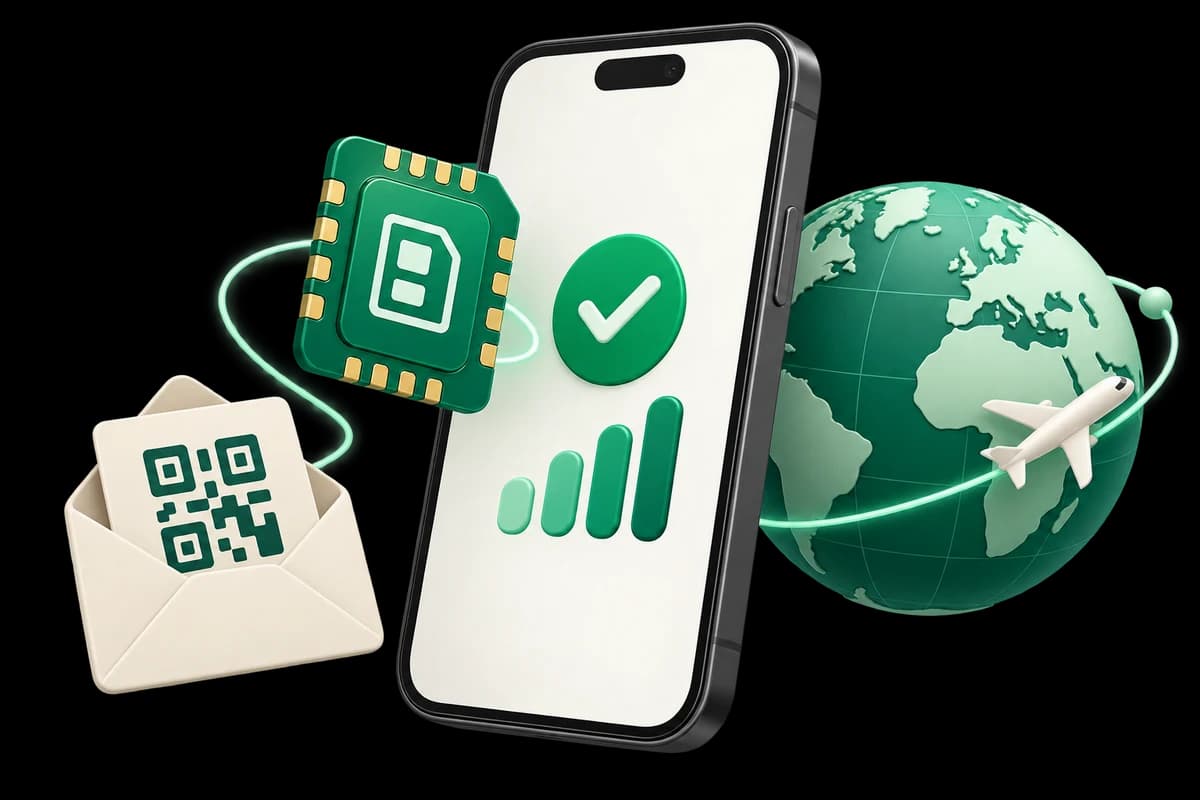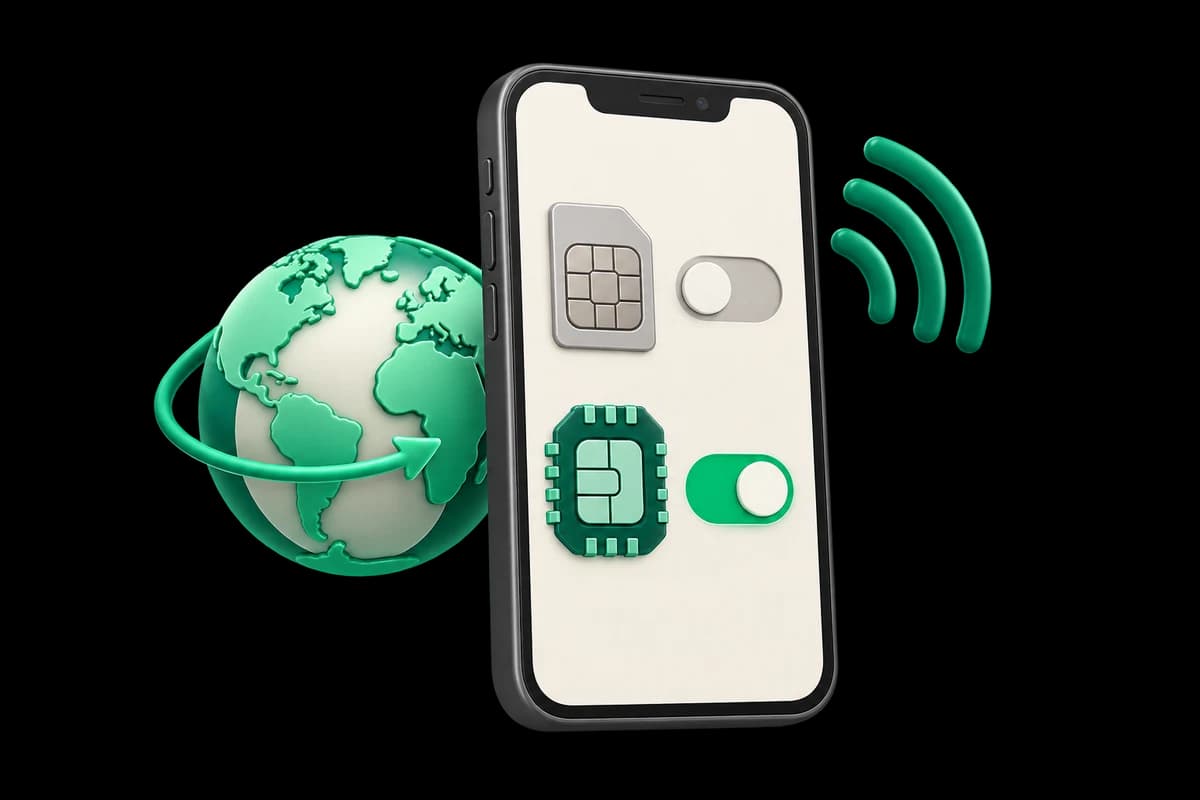
Yes: if your phone supports the combination of lines you need, you can use a data eSIM in the United States while keeping your usual number on its original SIM. These are separate functions. The travel eSIM supplies internet access; your home carrier still manages the number, traditional calls and SMS on the other line. The US packages described here do not include calls or SMS and do not give you a US phone number for those functions. Keeping your number also does not mean using it abroad is free. Check your home carrier's conditions before leaving that line active.
First decide why you need to keep your number
This question often comes up when preparing maps, family messages and account access. Separate those needs before buying data. Looking up an address or sending a message through an application uses an internet connection. Receiving an SMS sent to your usual number depends on the line that owns that number and the carrier's conditions. Calling from the phone's dialler may use that line's voice service even when mobile data is assigned to the travel eSIM. Having internet does not automatically replace those other functions.
Wikivoyage explains that SMS, RCS and other messaging methods coexist in the United States. There is no single application you should assume every business accepts. A restaurant, accommodation provider or transport company may publish a telephone number without accepting messages through the application you use. If a task requires number verification, check the service's requirements directly. Do not buy a data eSIM expecting it to solve verification that requires a local number: these packages do not include one.
As an editorial recommendation, prepare two contact channels before travelling: the one that uses internet and the one that requires your number. Check that you can access your accounts and retain an alternative method permitted by each service. You do not need to attribute application functions to the eSIM. An application already configured may use the available data under its own rules. Its registration, account recovery and device change requirements remain separate from the connection package.
The country's size changes the connectivity decision
The source distinguishes the 48 contiguous states from Alaska and Hawaii. Within the contiguous country, much of the population is concentrated near the Atlantic, Pacific and Gulf coasts or the Great Lakes. Between those centres are extensive agricultural, mountainous and sparsely populated areas. A visit to Manhattan or Chicago presents a different situation from a route through the landscapes of the Southwest. For data preparation, the relevant question is not just how many days you will travel, but where you need to find your way and what alternatives you will have if a connection is unavailable.
The Appalachians, Rocky Mountains, Sierra Nevada and Cascades structure large parts of the territory described by Wikivoyage. The Great Plains occupy a broad central area, while the shores of the Great Lakes alternate industrial cities and natural spaces. These geographical references explain why a commercial description saying “United States” cannot become a promise of identical signal everywhere. A country and operators listed in a package describe its commercial scope. They are not measurements of coverage at your road, accommodation or walking destination.
For a journey concentrated in one city, preparation can focus on the airport transfer, accommodation and urban transport. For a route through several regions, add downloaded maps, full addresses and an accessible itinerary copy. This is an organisational recommendation derived from the varied territory, not a claim that a particular place will lack service. If your trip includes Alaska, Hawaii or a US territory, expressly check the product's coverage and ask support when the description does not clarify that segment. Do not infer a territorial guarantee from the country name.
Flights, trains and roads: what to save before leaving
The corpus highlights large distances between cities and the importance of flying for longer trips by travellers with limited time. It also describes car, bus and railway journeys as other ways to explore when the itinerary allows. The distance between New York and San Francisco illustrates a scale that is easy to underestimate. For connectivity, the practical consequence is to keep your transport plan separate from your data plan. Internet lets you look up information, but does not shorten the journey or guarantee a connection inside the vehicle.
The Northeast Corridor runs between Boston and Washington, passing through New York, Philadelphia and Baltimore. Wikivoyage distinguishes it from other long routes in the national railway network. If your journey follows that corridor, save the exact departure and arrival stations and your ticket before leaving. On a longer railway route, also prepare the next connection and accommodation details. Current services and timetables must be checked with the transport operator. This guide does not turn a pinned travel text into a current departure board.
In cities the source identifies for public transport options, including New York, Chicago, Boston, San Francisco and Washington, data can help you consult connections and directions. On a road trip, Interstate highways connect major populations, while other roads take you into towns and places beyond those main routes. This difference matters when saving a map: retain the final approach to your accommodation, not only the route between cities. A departure address or a saved reservation can remain useful when a live search will not load.
Wikivoyage associates many visits to natural attractions with road travel or organised tours. If you visit Monument Valley or other landscape destinations, avoid making every part of your plan depend on checking the phone at any moment. Download what you need in advance, review the resources for the journey and use connectivity as an additional tool. The eSIM described here uses terrestrial mobile networks. It does not include a satellite service or a special connection covering every natural area in the country.
Before a route between several cities, connect each reservation with its full address and the transport you will use. A night in New York followed by rail departure towards Washington involves different documents from a flight to the Pacific coast. This comparison does not calculate journey times. The useful difference is which ticket, station or airport you need accessible. Preparing it keeps an orientation question separate from a package coverage question and helps identify the appropriate transport operator if the route changes.
Two real examples from the eSIMStore catalogue
The following facts come from the catalogue checked on 8 October 2026. They are fixed package examples and should be compared with the current product description when purchasing. They do not include a price or an invented estimate of each application's consumption.
United States 1GB 7Days: US_1_7
The US_1_7 package, United States 1GB 7Days, contains 1 GB with 7 days of validity. Its activeType is 2, meaning validity starts with the first connection to an eligible package network. The stated installation window is 180 days. Its published contractual networks are Verizon and AT&T, both labelled 5G. The general technology field says 3G/4G/5G. None of these technology labels guarantees a particular speed on your device or at your location.
The description confirms hotspot support, but shared traffic uses the same contracted data allowance. It also declares includesCalls=false and includesSms=false: this is a data package. The provider's routing label, ipExport, is US. We do not interpret this as evidence of a local IP address in every session. The fair usage policy field is empty in this snapshot, which does not convert the contracted gigabyte into unlimited data.
United States 5GB 30Days: US_5_30
The US_5_30 package, United States 5GB 30Days, offers 5 GB over 30 days, with activeType=2 and a 180 day installation window. It lists Verizon and AT&T, both labelled 5G, and supports sharing internet through a hotspot. Its calls and SMS fields are false. The general technology label is 3G/4G/5G, the reported routing label is US, and the snapshot does not publish an additional policy in fupPolicy.
Choose between these examples by considering validity and volume separately. Thirty days does not mean thirty days of unlimited consumption. Having data left also does not automatically extend a package whose validity has ended. Avoid making the decision through rigid equivalences between gigabytes and tourism days. Photos, video, backups and traffic from other devices change your usage. Review your existing consumption and the tasks you can prepare before travelling using an available connection.
Installation and activation do not always happen together
The two examples above start with the first eligible connection, but the US catalogue also contains variants with another mechanism. United States 100MB 7Days, US_0.1_7, has activeType=1, which starts validity on installation. This package contains 100 MB, lasts 7 days, states a 180 day installation window, lists Verizon and AT&T with 5G labels and supports hotspot. It does not include calls or SMS. Its smaller allowance and installation start prevent it from being treated as equivalent to the other examples.
Do not follow a universal instruction to install any eSIM now and expect its days to start on landing. Check the exact package mechanism in your order. The installation window and service validity are different concepts. For the 1 GB and 5 GB examples, prepare installation with a dependable internet connection and follow the order instructions. On arrival, check that the travel line is selected for data and can connect to an eligible network. Keep the QR and activation code private.
Configure two lines without confusing their functions
Before purchasing, verify that your phone model supports eSIM, is carrier unlocked and allows the simultaneous line combination you need. Apple's instructions and Google's Pixel documentation explain line management, although menu names change with devices and versions. Do not assume every model supports identical configurations.
After installation, assign recognisable line names such as “Home” and “US travel.” Select the travel line for mobile data and enable roaming on that line when the order instructions require it. Disable data roaming on your home line and automatic data switching if the phone offers that option. These steps help control which service supplies internet. They do not guarantee that the home carrier will never charge for calls or other services you keep available.
Make the first check without relying on Wi-Fi. Open a simple page using mobile data and verify the selected line. If there is signal but no browsing, review the data assignment, travel eSIM roaming and the order's specific APN. Do not copy an APN from another product or delete the profile as your first troubleshooting attempt. Support needs order information and the observed connection state. Sharing the QR publicly does not help diagnosis and exposes activation information.
Limits to understand before the journey
The product description identifies network options, not continuous coverage. Equipment, location, surroundings and network availability can affect the connection. Contractual access to Verizon and AT&T does not mean both are usable at every point or that the phone connects to both at once. A 5G label also cannot be used to advertise a guaranteed speed.
Hotspot uses the existing allowance. A connected laptop may run updates or synchronisations you did not anticipate, so review its settings before sharing data. Provider metadata describes top-up support, but does not establish a confirmed customer top-up flow at eSIMStore. If you need more data, check the actual order or catalogue options before planning an extension. We do not promise a top-up button or automatic continuity after the volume runs out.
Accommodation, airport and business Wi-Fi appear as options in the corpus. Their existence and specific conditions need checking at the location. They may help install the profile or download resources, but are not part of this package. Save the reservations you need so that access to a station, vehicle collection or accommodation contact does not depend on finding a Wi-Fi service at that moment.
Specific questions about your number and data
Does the eSIM change the number people know?
The data package does not assign you a voice or SMS number. Keeping the SIM of your usual number keeps that line under its carrier. Applications and verification processes have their own conditions. Check them before modifying an account or changing devices during the trip.
Can I receive a bank SMS through the travel data?
Do not attribute that capability to the package. An SMS addressed to your usual number belongs to that line and its carrier. Check roaming availability and conditions, and prepare an alternative method authorised by the service when available. Internet access and SMS reception are different functions.
Does US data continue in Canada or Mexico?
These examples publish the United States as their coverage country. Do not assume a border crossing is included. Check the purchased package's list or choose one explicitly covering your route. Read the guides to validity mechanisms in Canada and hotspot and data limits in Mexico for those journeys.
What should I prepare before a road segment?
As an editorial recommendation, download the map and save departure, arrival and accommodation addresses, together with tickets and reservations. This follows from the country's scale described in the corpus and the absence of an everywhere coverage guarantee. Verify the route with transport sources before leaving. Compare available plans and consult installation and frequently asked questions to prepare the device.
Sources, credits and scope of this adaptation
The territory, transport and messaging context is a selection and adaptation of text by Wikivoyage contributors, United States, revision 5269284. The edit history and authors document the original attribution. vincentss curated enwikivoyage-retrieval-202605, pinned at 509ec2fe1ed76f90d28fd0eebf7a70f108ae5b1b. This context is a pinned snapshot and does not guarantee future conditions.
eSIMStore selected the relevant passages, produced this English companion to the Spanish adaptation and added editorial preparation advice and catalogue facts checked on 8 October 2026. For data, voice and hotspot functions, see eSIM Access documentation; for validity start mechanisms, see its activation explanation. The adapted text is available under CC BY-SA 4.0. eSIMStore brands and graphics are excluded from that licence.